Sunday, July 28, 2019

Steven

Still working on this....

Stephen-

It all started when the Grecians complained.
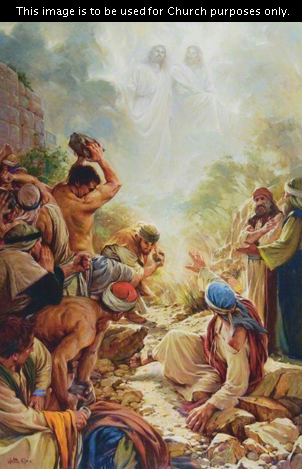
The poor, needy, and widows need help.
Stephen was ordained and chosen to go.
Great miracles and wonders were performed.
But many were angered at his teachings
And many people lied to stain his name

Proclaiming the Law of Moses was fulfilled,
Many would not changed their sinful pride
Brought before the Sanhedrin, he stood firm
"Remember the past prophets?"  "Their martydrom?"
"Israelites shunned Moses and the Law,"
Stephen sternly spoke: 'You are stiffnecked!"
"Uncircumcised in heart!" "Rejecting the One!"
"Ye do always resist the Holy Ghost."

"Blasphemy!" they yelled! "You are blasphemous!"
Paul, watching, praying, looking downcast.
Then, Stephen's face brightly, so brightly glowed.
Speaking boldly, "Obey God's commandments!"
The heavens opened, and Stephen saw God.
Transfigured, he saw the Son of Man, too.
The wicked did not listen, could not see.
They cast him outside the walls of the city,
Rocks in their hands, throwing aside their dark coats
By Saul, who did nothing, and said nothing.
Stones, crushing, "Lord, Jesus receive my spirit"
"And please Lord, forgive these wicked people."

Acts 7:51-56


Wednesday, July 17, 2019

Moody Muskrat


https://www.katemessner.com/cheerful-chick-learning-from-a-mentor-text/

Teachers Write 717/19

Martha Brockenbrough’s CHEERFUL CHICK, illustrated by Brian Won, is a celebration of both cheerleading and determination. It’s a great mentor text for us to study as we take a look at the way the topic and theme of a book guide decisions about rhyme and meter.

Remember the cheers you heard at basketball and football games? There’s probably one catchy cheer that comes to mind right away. For me, it’s this one:

We got spirit, yes we do!
We got spirit, how ‘bout you?

It has a peppy meter to go along with the rhyme.

DAH da DAH da DAH da DAH!
DAH da DAH da. DAH da DAH?

Martha kept that element of cheerleading in mind when she chose her rhyme scheme and meter for CHEERFUL CHICK. It’s written in iambic tetrameter, so each line is made up of four iambs. In other words, it goes like this:

da DAH da DAH da DAH da DAH….

Interestingly enough, Martha’s first draft of this book wasn’t written in rhyme. As an experienced writer, she knew about all the pitfalls of writing in rhyme and opted to try it in prose instead. But when she sent the manuscript to her editor, Arthur Levine, he suggested that this is a story that might actually work better with the added challenge of rhyme.

“Since I already had the character and story, though, the challenge was to come up with a rhythm and rhyme scheme that echoed the cheerleading protagonist’s nature,” Martha wrote in an April tweet thread.

She came up with a plan to give iambic tetrameter a try. When I look at how this book turned out, I can only imagine how much fine-tuning and revision went into making this work. But the end result is a book that captures the main character’s nature and rhymes without feeling forced or clunky. It reads like a cheer, which is perfect.

Cheerful chick worked day and night
Until at last her moves felt right.

And then she hatched her lifelong dream
To build a barnyard cheering team.

She got her muscles good and warm
And did her moves with perfect form:

Side splits, wing stands, super punches –
Chicken shook her feathers bunches!

That last line was fun, wasn’t it? When we were looking at Hena’s GOLDEN DOMES AND SILVER LANTERNS yesterday, we talked about the care she took to make sure the rhymes felt natural and didn’t call attention to themselves, because that’s a gentle, lyrical story about colors. CHEERFUL CHICK has a more playful, humorous tone, so it’s fine (and fun!) if some of the rhymes stand out a bit more:

Ms. Cow knows all the wildest moves.
Just watch her stand on two front hooves!

Ms. Cow just stood and blinked and chewed.
And said, “I’m so not in the moooood.”

On that note…here’s your assignment. We’re going to play around with some different voices today. Choose a character — a young person, a big old tortoise, a rowdy squirrel…whatever you want — and try writing a few lines in that character’s voice. It can be about anything – what the character loves, their plans for the day, their dreams for the future. But give some real thought to how the rhythm and word choice will reflect the character. When you’ve written a few lines, switch gears and write about the same topic but in a different character’s voice. How does that change how you think about meter and rhyme?

My response:

My friend and I were on a hike today, and we encountered a rattle snake. Funny, because I wrote about a snake yesterday. Anyway, I had read the post before I left and asked her to think of a fun animal. We came up with Moody Muskrat. I am on the west coast, wanted to post sooner. Here is my attempt. The second to the last line has too many syllables, but I liked the word scampered. I will have to keep working on it.

Moody muskrat slept snug in his bed.
It's time for school, his mother said.

Moody muskrat, blanket in tow
Please momma, I don't want to go.

Your teacher is a wise old owl
Comb your fur, and fix your scowl.

But I don't like reading out loud
Rather swim and gaze at the clouds.

Momma packed his lunch, out he went,
Long tail barely swishing, head bent.

Chirpy chipmunk scampered into a run
C'mon friend, school can be fun.

Owl's smile extended warm and bright
As little animals crowded in tight.

Story time, a favorite for all
Moody muskrat had to sit up tall.

Scary forest and a magic fairy 
His scowl disappeared, just barely

Moody muskrat still couldn't see
Rabbit, your ears are too close to me!

Just talk nicely, Owl reminded all
Moody muskrat's face began to fall.


pass


story


be, tea, me, be, free, knee

Hand raised, Can we read once more?

 
for, galore, store, more


Tuesday, July 16, 2019

Silly is My Laugh

Teachers Write

https://www.katemessner.com/golden-domes-and-silver-lanterns-learning-from-a-mentor-text/

It’s important to note that when you’re writing verse like this, the rhythm doesn’t have to be exact. An extra unstressed syllable at the beginning of a line isn’t a deal breaker. But the overall pattern still has to be there. It has to work when you read it aloud.

Reading aloud is a great way to find out if your rhyming picture book text is working, but it’s not perfect. Sometimes when we read our own work aloud, we can force a rhythm to sound okay by the way we read it.  If you really want to know if the meter is working, don’t just read it yourself. Hand it off to someone else to read aloud for you. Does the verse roll off their tongue in the rhythm you intended? Or do they stumble a little here and there? That will tell you where your meter might still need work.

Now let’s take a look at the rhyme in this book. One of the trickiest things about writing picture books like this one is that it’s not enough to find two words that rhyme. They have to be the right words.  And in this case, Hena had the added challenge of working with some very specific language that relates to Muslim traditions and culture – words like Eid, hijab, kufi, Quran, and deen. For some of those, she chose to use related words as her two rhymes:

White is a kufi,
Round and flat.
Grandpa wears
This traditional hat.

On that note, I’ll send you off with a short assignment. Remember last week’s writing about gratitude, using Traci Sorell’s WE ARE GRATEFUL: OSTALIHELIGA as a mentor text?  I’m going to ask you to reimagine that idea as a rhyming picture book. Make a list of some of the words you know you’ll want to include – elements of a tradition or culture or season. And then have a go at it, using Hena’s GOLDEN DOMES AND SILVER LANTERNS as a mentor text. You can try the same rhyme scheme if you’d like, or use a different one. When you finish a few lines, read out loud and see how the meter’s working out.


Silly is my laugh,
giggles and hoots.
Dad tickles 
after I take off my boot.

Afraid are my eyes,
Wide and brown
Snake wriggles
with a hissing sound.

Surprised is my face
Open mouth
Pink birthday cake, 
Blow candles, sing loud!

Nervous, my stomach
Quiver and shake
Monsters and goblins
Yikes! Am I awake?

Sad are my wet tears
Face is red.
Mom stressed that
it is time for bed.

Embarrassed hot cheeks,
Flushed and pink
Pretty Easter dress
Stained with orange drink.  

Curious is brother (sister)
Babbling on
Reaching chubby hands
Bubbles on the lawn.

Love is helping mom
Eager and bright
Toys are put away
Ready for "Good night!"


Monday, July 15, 2019

Sasha The Cat


Writing in Rhyme (is a lot trickier than you might think!)


This spring, Lin-Manuel Miranda of Hamilton fame set the children’s Twitterverse on fire with a casual tweet about how bad he thought most rhyming picture books were. Aside from Seuss and Boynton, he hadn’t read many he liked. His complaint was met with an avalanche of tweets suggesting the good rhyming picture books. They’re not all bad, you know. So why do rhyming picture books have such a tough reputation?

The truth is, it’s just plain hard to write in rhyme. Think about it. How often do the exact words that express what you want to say happen to rhyme? Not very often, I’ll wager, which is why writing in rhyme sometimes leads authors to choose words that are…not just-right words. Here are some examples of that…

The Overly Simplistic Rhyme:
I like to write in rhyme.
I do it all the time.

The Not-Really-a-Rhyme-Rhyme:
If you like to read rhymes
You should read some of mine.

The Weirdly Forced Rhyme:
When you write in rhyme, you must count each syllables
That’s laying good groundwork, like soil that’s tillable.

(I mean, really… not much rhymes with syllable!)

https://www.katemessner.com/writing-in-rhyme-is-a-lot-trickier-than-you-might-think/#comment-103134

My response:

Thank you for the great post. Last week, I put a request for both of these book at our city library. Rhyming is hard! I like cats, and even though I don't have little children running around anymore, it brought back memories of when they were running all around our house. At the moment, we only have a dog, but I hope to get another cat sometime as my cat of 18 years passed away.

Sasha was enjoying her morning nap.
Until she was pushed off the large arm chair.
Padding upstairs, she found sister's lap,
But brother and his truck, she flew with a scare.

Leaping on the bed the pillow so inviting.
"Go somewhere else, Sasha. I'm wrapping presents."
Down the stairs she crept and heard the doorbell ring,
As the door opened darting outside made the most sense.

Friday, July 12, 2019

Friday Feedback

Thanks so much for sharing your truthful writing journey. I am still trying to find my voice. I especially like your one liners after the dialogue: I blink in disbelief. His head tilts as he studies me. My jaw drops. His eyes gleam. Showing not telling. Great banter going on.
I am sharing an excerpt from something I have been working on very slowing. I only have one chapter. The character is based on our experience with adopting our own daughter from Tonga. Our daughter has also given me details. When I start to crawl, my mother wraps me around her waist with a bright cotton cloth, and we walk three or four miles to the bush. The bush is ghetto. The bush is shacks, no electricity, plumbing, or phones. My mother’s mother is there; grandma, kui fefine, barely a grandma herself, for she was sixteen when she bore her first child.
“Still sleeping with married man?” says kui fefine.
She ignores her mother’s question, and instead asks: “Can you take Samena for awhile? She is crawling now, and I cannot keep her.”
“I have five other mouths to feed, and where will I get food for them and her?”
“I will send money.”
Kui fefine swats at a fly around her head. “Did you see that woman in town who is taking babies to America? You should talk to her, better life for Samena.”
That is my name. Samena. My mother did go see the woman from America, and the woman gave her some instructions of things for her to accomplish before she could take me to America. First, my mother took me to a dingy clinic in which a German doctor with a cigarette hanging out of his mouth had to sign a paper that I was fit. Then, I had my picture taken for a VISA, and I look sad. I was three and a half by the time everything went through. I know all these things because my adopted mother told me. I asked her over and over again to tell me about my birth mother, tell me about Tonga, tell me anything and everything.
This is what she knows, and what I know. My mother was 15 when she had me. Her mother, kui fefine, kicked her out because she disgraced her family hooking up with a married man. So, my mother lived in a shack with another girl who was also in the same predicament.
I was three when I boarded a plane with a lady who put a new dress and some new underwear on me. My ears hurt on the plane and I was scared of the toilet. I watched out the window as the palm trees swayed, and the ocean stretched out. I had never seen the ocean, and I did not know what it was. I pointed, and the lady said, “tahi,” or sea. The blue green water looked like swaying grass. I awoke once in the semi-darkness, and cried out for my mother. The lady comforted my whimpering, and I fell asleep. When I woke again, the gray dawn was peeking through the small window.

Wednesday, July 10, 2019

Five People whose lives are interesting

Teacher's Write

https://www.katemessner.com/joan-procter-dragon-doctor-learning-from-a-mentor-text/

So here’s your assignment for today: Make a list of five people whose lives you find interesting. They can be famous historical figures or little-known people who have amazing stories. And then, for each one, try to imagine three different ways you might write a picture book biography of that person, other than the cradle-to-grave model. For example, in writing about George Washington, one might choose to focus on Washington the Soldier, or Washington the Enslaver, or on one small chapter in Washington’s life that changed its course. Got the idea? If you need to take a little reading & research time, go right ahead. And then spend a little time brainstorming angles for your own picture book biographies!

Cliff Young Australian potato farmer- at age 61 won the Sidney to Melbourne Ultramarathon. 544 miles Never stopped to sleep. 
Storyline: Write about the race with flashbacks about his childhood as a boy. He said he could run that long because he had to round up the cattle when he was young and they were so poor they couldn't afford horses.

Mileva Einstein-Maric - Einstein's first wife. Brilliant scientist in her time. Born with a displaced hip, life-long limp. So gifted that her parents were able to put her in an all boys high school. 
Storyline: Her parents were a bit embarrassed about her hip (disability). Write a children's book about her early years or going to an all-boys school. What obstacles she had to face. 

http://www.markfisherauthor.com/category/celtic-monks/
Celtic Monks - 800 A.D. What was it like to live in a monastery? 
Mill on the river
limekiln
ring a bell to summons to dinner or prayer
work on manuscripts in a scriptorium
Leather satchels hang from the ceiling, writing is done on calfskins which have to be scraped and cut.
Fasted twice a week. 
Storyline: a fictitious monk, historical fiction picture book. 

Christine Paxton - called Tissie - my mother's mother, my grandmother
Born on the Onward Ranch, Williams Lake, British Columbia, Canada 1895, one of eleven children.
Mother, Agnes, died at age 42. Sent to live with the Borlands at age 3 or 4.
Raised by the Borlands who were wealthy and gave her many advantages that she would not have had.
Excellent horsewoman, her horse's name: Morning Plume
Excellent pianist, played for silent movie house and many dances.
Engaged to Nassau, but ran off and married Herbert Spencer (she was pregnant, oops)
Married 1912 at age 17.
Contracted tuberculoses and her first born daughter dies from tuberculoses at age 21.
Tissie helped Herbert start the William's Lake Stampede.
She rode her horse in many of the events. She helped make the crown for the Miss William's Lake Stampede Rodeo Queen.
Storyline: Being sent to live with another family after your mother died who gave her advantages she would not have had otherwise. Focus on piano lessons, riding a horse, and living in a sanitarium while she had tuberculoses, losing her first born daughter. (My mother had to stay with relatives while she was in sanitarium).

Tuesday, July 9, 2019

My Wonderings

First day of Teachers Write ~July 9, 2019
What do you wonder about? Spend ten minutes making a list. It can be anything from Komodo dragons to how babies learn to what happens in our brains when we cry. Anything you’ve ever wondered about. Because wonderings can be the best beginnings for writing. Ready…set…wonder!


These are my wonderings.
Whenever I travel, I find out interesting things about places or things. I just got back from Ireland, and one of the places we visited was Trinity College and saw the Book of Kells. I have seen this book one other time and bought a book about the Book of Kells. I find it very fascinating, and it is considered the FIRST bound book that the world has. Monks copied the first Four Gospels onto calfskins that had been scraped. Anyway, it is beautiful and interesting to me.
Other things that I find interesting:
-The Irish have over 50 names for rain
-I have an interesting grandma who eloped at 17 with a ranch hand instead of marrying her fiancé who she was promised to. Her life is really interesting.
-I have a lot of pioneer heritage and we have a few journals with interesting stories that I have wanted to fictionalize.
– I read an article about Korean’s Jeju Province (Marado) where only women free dive. They can hold their breath for more than two minutes bringing up treasures such as sea cucumbers, conchs, and abalone. The diving might have started with men, but by the 18th century the discipline became women alone.

Teachers Write 7/9/19 Showing Gratitude

Today, we’re going to take a closer look at We Are Grateful: Otsaliheliga, written by Traci Sorell and illustrated by Frané Lessac. It’s a beautiful and lyrical picture book that’s won a pile of awards, including a Sibert and Boston Globe Horn Book Award Honors.

In fact, if you have the book, read it aloud right now. (It’s okay. I’ll wait…) And as you do, jot down the phrases that feel particularly evocative, the places where the word choice really sing. What did you notice?

Here’s one more assignment for today. Try a little writing of your own about gratitude. Choose a season and using Traci’s structure as a mentor text, write a few lines about that season and what it means in your world, what you’re grateful for, and perhaps how you express that gratitude. Consider a repeated refrain. Consider word choice. Make that season sing.

So many beautiful word choices, but these really spoke to me:
"burnt cedar's scent drifts upward during the Great New Moon Ceremony"

"While we collect buckbrush and honeysuckle to weave baskets to remember our ancestors who suffered hardship and loss on the Trail of Tears."

I took a Native American class at Northern Arizona for my Masters in English and I loved that class. I was introduced to so many new and amazing Native American authors. My great great grandmother was a Canadian Indian - Shuswap, British Columbia. My mother was always so proud of her ancestry, as I am. I am 14% Native American according to my DNA. Here is my attempt at gratitude and although sloppy and quick, thank you Traci Sorell, as I used your "template." I based this on our first granddaughter who was born last year. We had 4 grandsons, and it was so fun to finally have a granddaughter.

When new life is placed in your arms and names run through your head, we thank God.
as our ancestors nod, cousins smile, and grandparents cry, and lilac's sweet scent floats around outside during the Christening Ceremony.
as we clean the house, wear our church best, enjoy a celebration meal, and forget past hurts and quarrels.
while we each take turns holding the new infant, each hypothesizing who she looks like most...
and have hope as our Nana cradles the newest babe of the family and smiles because the girl holds her name.

As she sleeps deep and summer arrives, the baby fattens, and the sun beams, we thank God.
when we watch the stars and wade in the creek camping next to the cool mountains.
as we sink our teeth into the juicy watermelon during the Fourth of July fireworks.
while we scramble to chase a baseball that Grandpa hit over in right field.
when we recall our forefathers sacrifices to preserve our way of life, her future life.

When fall leaves fill the sidewalks and a cool breeze blows, we thank God.
While baby girl sits up and her wide eyes look all around her, we gather the last of the pumpkins and squash
and we practice patience as baby's first tooth tears through, first cold, and sleepless nights.
as we hold hands around the sumptuous feast, and younger ones fight over the wish bone, and mom's sweet-smelling rolls reminds us not to argue with each other.
as we embrace our nephew back from Iraq, serving our country.

As the toddler sleeps and snow envelopes the ground, we thank God.
While great Uncle shares stories and we savor hot chocolate and cinnamon toast.
When we create caramel corn, and Christmas cards.
As older brother teaches younger sis to sing eency weency spider, and play cars.
While we gather to remember our Savior's birth as dad cuddles the newest member of our family and we sing traditional Christmas carols, especially Rudolf the Red Nosed reindeer.

Every day, every season. Thank God.

Friday, July 5, 2019

The Book of Kells


The oldest bound book in the world enshrined behind glass.
Prestige for Trinity College.
Most likely monks from the wind-swept island of Iona, Scotland, then to County Meath, city of Kells.
Twelve hundred years ago, who labored over the calfskins.
Scraped with a pumice, stretched, cut, and flattened.
The vellum is colored with brilliant inks of purples, lilacs, reds, pinks, greens, blues and yellows
from lead, orpiment, and lapis lazuli.

The Four Gospels, based on Vulgate.
The Four Evangelists, Mathew, Mark, Luke, and John, are depicted as man, lion, calf, and eagle
spread throughout the 150 calfskin pages of water and lime, scraped with pumice, stretched, cut, and flattened.

The illustrators, or better known as the illuminators, worked diligently, possibly for 30 years or more, while practicing obedience, chastity, and poverty.
While bowing seven times a day, while exerting in the garden, fishing, beekeeping, or singing: Ánima Christi, sanctífica me. Corpus Christi, salva me. Sanguis Christi, inebria me.

Illuminating the text, day after day.
Miniatures of humans, mythical beasts, and animals.
The insular art of deep purple, reds, and yellows while fasting, and creating stunningly complex details.
Virgin and the Child, the Temptation of Christ, or the Arrest of Jesus.

The scribes in their scriptorium, goose feather quills in hand, dreaming, creating, ornamenting.
Eight beatitudes, four embellished swans, four embellished humans.
Symbolic ichthus fish for Jesus Christ, son of God, Savior.

One hundred and fifty-eight complex interlacements of white ribbon, complicated knot work, interweaving when there was no magnifying glass. So devoted to God's work, and their craft.


Soul of Christ, sanctify me. Body of Christ, save me. Blood of Christ, inebriate me.